
 Tiếng Việt

Specification
High resolution CMOS readout system
Low total cost of ownership
Vacuum optics enabling fast stabilization
Excellent long-term stability
Intelligent design, Modular design
Ferrous and non-ferrous applications
Easy to use with full PC control
Friendly user interface
Summary:
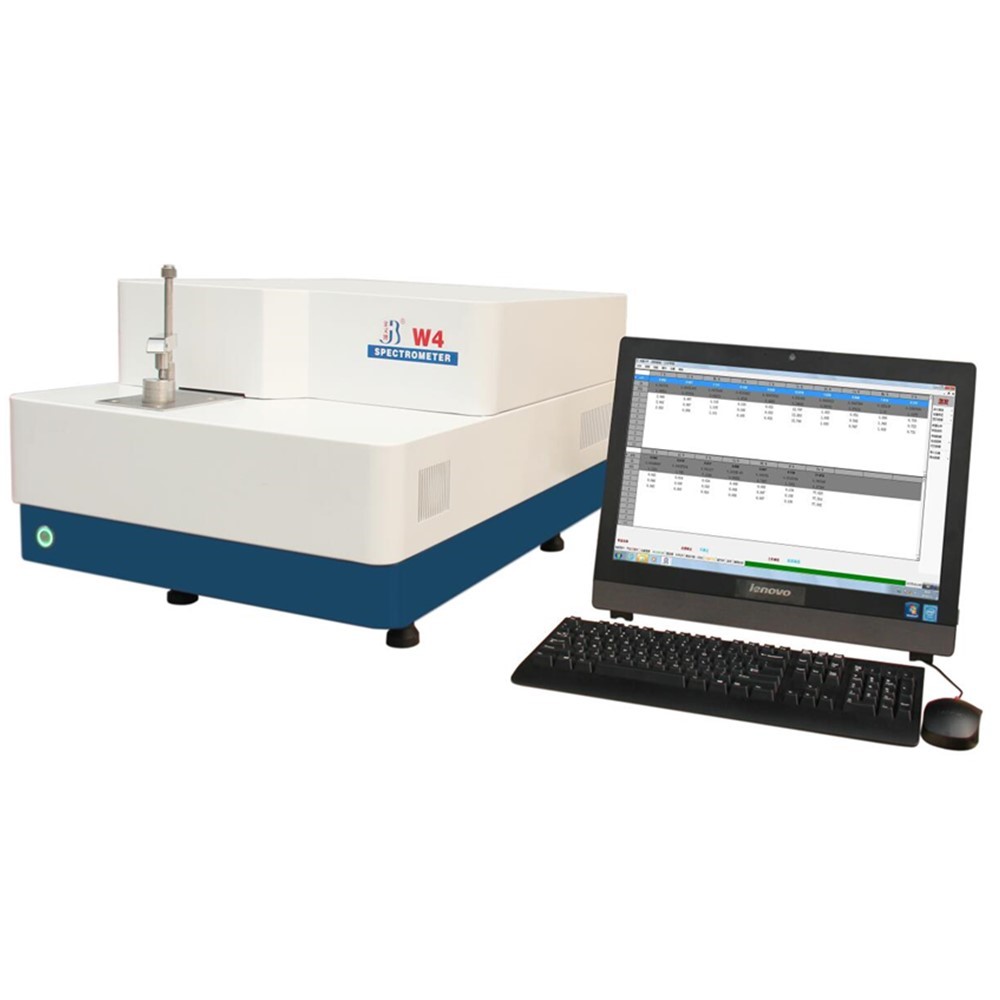
W4 Optical Emission Spectrometer is most suitable instrument for the determination of various elements in different matrices (Fe, Cu, Al, Ni, Co, Mg, Ti, Zn, Pb, Sn, Ag, etc). It is an economical and easy solution to quick analysis near the furnace, metal material quality analysis, research laboratories and metal grade identification
This also gives the user a truly economical spectrometer that’s both easy to use and easy to space saved. The optical system uses a CMOS detector with a spectral range covering all typical materials. It can accurately and reliably analyze from low-level elements to high-content elements.
Application:
Steel plants where needs are at around 100 PPM levels or elements like C, Cr, S, P etc.
Rolling mills, foundries, workshops: Rapid analysis; test several 100s of samples daily
Alloy manufacturers: Any number of bases / matrices; highly stable and precise
Testing Laboratories: Commercial testing laboratories, Universities and colleges
Medium-sized industries: Extremely rugged and economical; low cost / analysis
Foundries which need a quick analysis near the furnace
Warehouse material identification
Base: Fe, Cu, Al, Ni, Co, Mg, Ti, Zn, Pb, Sn, Ag, etc
Detection Matrices:
Iron(Fe) and its alloys (Steel alloy, Cast iron, Fe-Low alloy, Fe-Cr steel, Fe-Cast iron, Fe-Cr-cast, Fe-Mn steel, Fe-Tool steel etc.)
Aluminium(Al) and its alloys (Al-Si alloy, Al-Zn alloy, Al-Cu alloy, Al-Mg alloy, Pure-Al alloy etc)
Copper(Cu) and its alloys (Brass, Copper-Nickel-Zn, Aluminum Bronze, Tin-lead Bronze, Red Copper, Be-Bronze, Si-Bronze etc)
Nickel(Ni) and its alloys (Pure Ni, Monel metal, Hadtelloy Alloy, Incoloy, Inconel, Nimonicetc)
Cobalt(Co) and its alloys (Co-orientation, Low Co alloy, Stellite 6,25,31, Stellite8,WI 52, Stellite 188, F)
Magnesium(Mg) and its alloys (Pure Mg, Mg/Al/Mn/Zn-alloys)
Titanium(Ti) and its alloys
Zinc(Zn) and its alloys
Lead(Pb) and its alloys
Tin(Sn) and its alloys
Argentum(Ag) and its alloys
Manganese(Mn) and its alloys
Chrome(Cr) and its alloys
Small sample, special size sample and wire detection
Features
1. Optical system with superior performance
The Paschen-Runge structure concave grating, full spectrum coverage, meets the customer’s need for full element detection.
Direct optical technology and use optics made with MgF materials ensure optimum performance in the UV region.
High resolution multi-CMOS readout system, lower dark current, better detection limit, higher stability, stronger sensitivity, meet N analysis requirements.
2. Large energy digital spark light source
Fully digital intelligent composite light source DDD technology brings superior analytical performance.
The compact design and semiconductor control technology make the light source more stable and more reliable.
High-energy pre-combustion technology(HEPS), spark parameter adjustment, fully meet the excitation requirements of different substrates, different samples and different analytical elements.
3. Humanized sample spark stand design
The spark stand directly introduces the spark light into the optical system
Open sample stage for large sample testing requirements.
Change electrodes provide better performance for small sample and complex geometry samples
4. Simple argon flow design
Intelligent argon flow design and dust collection and cleaning device
The unique argon jet technology effectively eliminates the drift of the plasma during the spark process, ensuring that the CCD detector can observe the high-temperature regional light signal, improving accuracy and stability.
After sparking, pulsed argon purge improves dust removal and improves instrument short-term and long-term stability.
5. Fully intelligent vacuum measurement and control
The vacuum system is fully programmed to reduce the running time of vacuum pump while ensuring the vacuum.
The two-stage setting turns on the standby vacuum operation state when the instrument is not running.
Multi-stage vacuum isolation measures and the addition of oil filter devices ensure that optical components work in a reliable environment.
6. Convenient and quick lens cleaning device
The integrated vacuum ball valve has good isolation when cleaning the lens.
Single-plate lens design, easy to assemble and disassemble.
Cross-mechanical devices, the optical system is effectively protected without isolation.
7. Cloud computing and reading system
The computer and mobile phone (or PAD) can be displayed simultaneously for easy panel operation.
High resolution multi-CMOS readout system and FPGA, DSP and ARM technology for data acquisition.
Ethernet and TCP/IP protocols, data transmission is fast and reliable.
Data can be transmitted remotely and fully networked. Real-time monitoring and control of the operating state of the instrument.
Data can be cloud printed.
8. Dedicated spectral analysis software
The international spectrometer produces a standard dedicated spectrometer software with user-friendly interface and standardized functions.
The instrument is equipped with multiple factory calibration curves and more material analysis methods and advanced solutions in the software.
The upper and lower limits of the standard curve can be extended on site according to the material requirements of the user.
9. The instrument and software computing power is powerful
Automatic optical path calibration
Low argon consumption
Universal adjustable sample adapter
Base extension
Standardized parameter modification
Type standardization function
Safer, more open and convenient design
The result is displayed in real time, and the print report function can be customized for the user.
Software rapid diagnosis
Simple interface operation
Reliable factory calibration